By Penelope Sofias
In this week’s modules we learned how misinformation is often supported by confirmation bias, motivated reasoning, and an overstimulating flux of content that we interact with. With media literacy comes incredibly complex concepts and techniques for critical thinking. Through playing around with educational games like: News Literacy Project’s RumorGuard and Bad News, I was able to see firsthand why it is so easy for misinformation to spread. I found that breaking down complex ideas into a step by step game was a great way to understand misinformation and its effects. I would highly recommend these games as a tool for eradicating misinformation.
News Literacy Project’s RumorGuard:
In News Literacy’s “Verifying Social Media Content” interactive lesson the player is guided through real world events that have circulated in social media and the news. From a viral video of an eagle snatching a baby to a screenshot of a little boy who was a victim of an airstrike, the player is put into a fact checking position. By using strategies and tools, you go through different online stories determining their validity, their source, and the motive behind them. Throughout the game, I learned how there are a few handy tools that can be applied when sifting through misinformation, particularly from a news standpoint. These tools are called the “Three Pillars of Verification” where as the reader, I do my own independent research to establish the specific source, location, and date of the content I engage with. Anyone can make a story public, but with a multitude of apps and channels at our disposal, it can be a challenging task to find the original source of information. This challenge can actually help information be manipulated or altered. Through this lesson, it became clear that pictures and videos can be used out of context to support an entirely unrelated claim. By using modern tools like reverse image searching and quite simply Googling (strategically), we can find specific information like source, location, and date to not only find the origin of information but to find the motivation and intent behind it. Understanding this motivation is the first step of determining the credibility of information. This lesson was very educational, teaching the player how to interact with misinformation. It was helpful that it used real world examples with a multitude of intentions behind them.
Discovering Intent:
Is this information being shared for someone’s financial gain? Or to encourage a specific ideology?

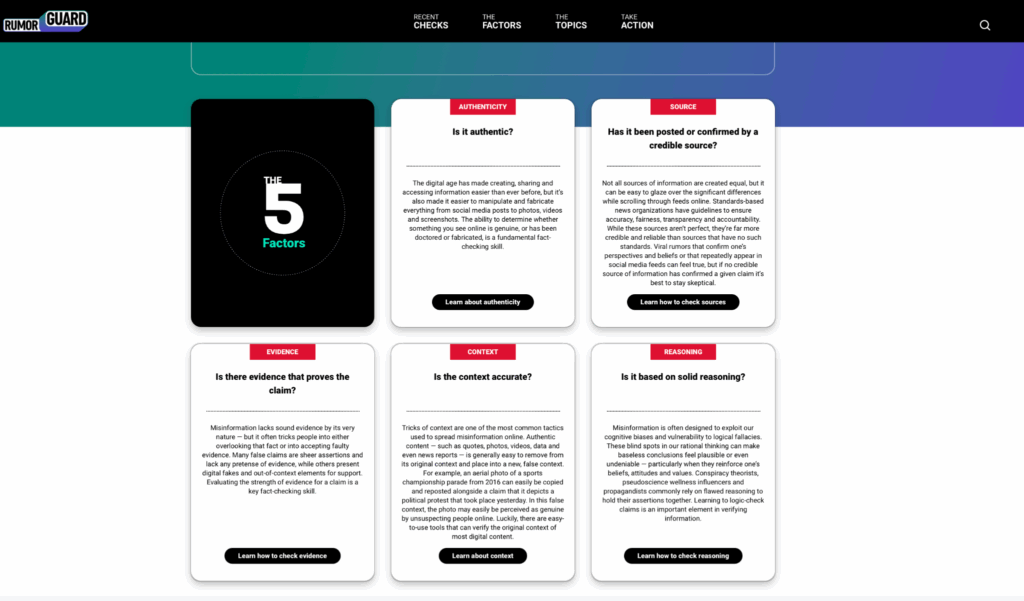
RumorGuard shares these “5 Factors” to protect from misinformation, factors that I utilized during my interactive lesson.
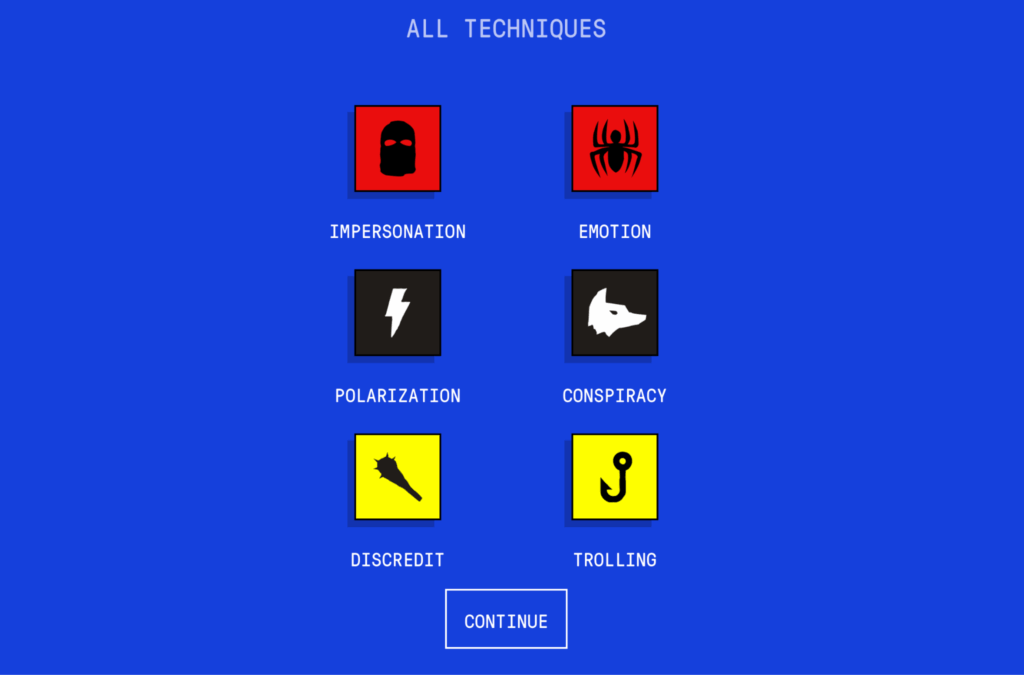
In the interactive game, “Bad News”, the player’s goal is to gain as many social media followers as possible, through any means possible. The figure that you interact with during the game takes on a devil on the shoulder type of role, egging you on and encouraging you to engage in online behavior from posting fake news, to trolling specific accounts, to preying on people’s emotions in order to get a response. As you go through the stages, you choose between different goals: Impersonating a public figure or impersonating a credible news source? Do you want to create an article or a meme? I was able to choose from stories to use as conspiracy theories like vaccines and virus breakouts or mysterious plane crashes and what they mean. It was interesting to be on the side of producing misinformation and how easy it is to do. This role relies on bots and algorithms that create an echo chamber of information for users. It’s concerning how easy it is to exploit online behaviors, and how dangerous it is to have confirmation bias constantly reinforced. While media literacy tools help to avoid being victim to misinformation, this activity also made me question the general system of social media. An article by The National Academy of Sciences of The United States of America talked about an intriguing concept of a reversed algorithm where we interact with “feed[s] that deliberately puts contradictory news in front of us”(Vol. 114, No. 48). Acting as the internet troll in this lesson made it clear that today’s social media code is the perfect breeding ground for misinformation.
As you continue through the game you don’t simply gain followers but also gain the technique for creating viral misinformation:
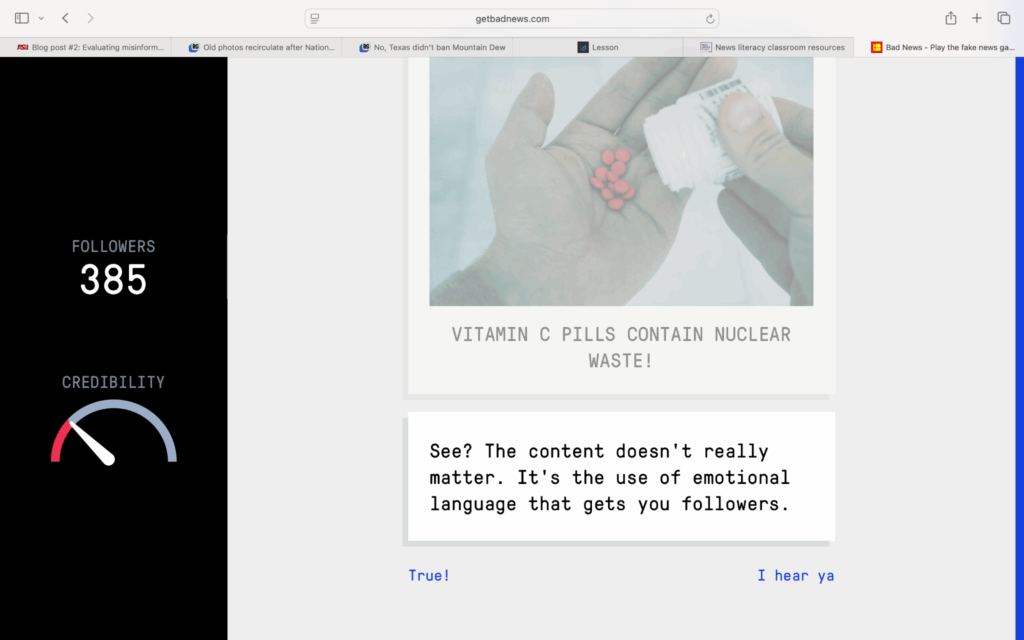
During one stage, I was learning how to play on a person’s emotions. It was intriguing how a certain level of exploitation gave me more followers, comments, and interactions. However, if my tweets were too extreme I would lose followers and be considered a “lunatic”. It was interesting to see how easy it is to manipulate current events into believable conspiracy theories. People love to interact with clickbait, without admitting that that is what it really is. Misinformation takes advantage of how people interact online, an article by MIT Sloan School of Management states that, “In a social media environment, there’s so much to focus on around the social aspects of sharing — how many likes will I get, who else shared this — and we have limited cognitive bandwidth”. Through excess information, flashy headlines, and the need to fit in, people readily believe and encourage misinformation. The “Bad News” game was extremely educational on why misinformation is so successful. It preys on basic human behaviors, from confirmation bias to mob mentality.
An interesting insight from Bad News:
I